
What is kirtan, and how can it transform your mindfulness practice? Kirtan is an ancient Sanskrit tradition of call-and-response mantra chanting that frees the mind, reduces stress, and promotes deep spiritual connection.
Whether you are searching for a powerful meditation practice or looking to connect with a welcoming community, this beginner-friendly guide explains exactly what happens during a Kirtan, the meaning behind the powerful Maha Mantra, and what to expect when you join us for your very first Kirtan With Friends in Brisbane.
What is Kirtan?
The word kirtan comes from the ancient language of Sanskrit, and refers to the practice of singing or chanting of spiritual names.
Deeply rooted in the Eastern traditions, it serves as a pathway to connect with our truest selves and with the Divine that strengthens and protects all of us.
It has been practised for centuries, and in recent years, its transformative effect on increasing mindfulness, reducing stress and promoting mental clarity has made it a vital part of meditation and mindfulness practice.
What happens in a kirtan?
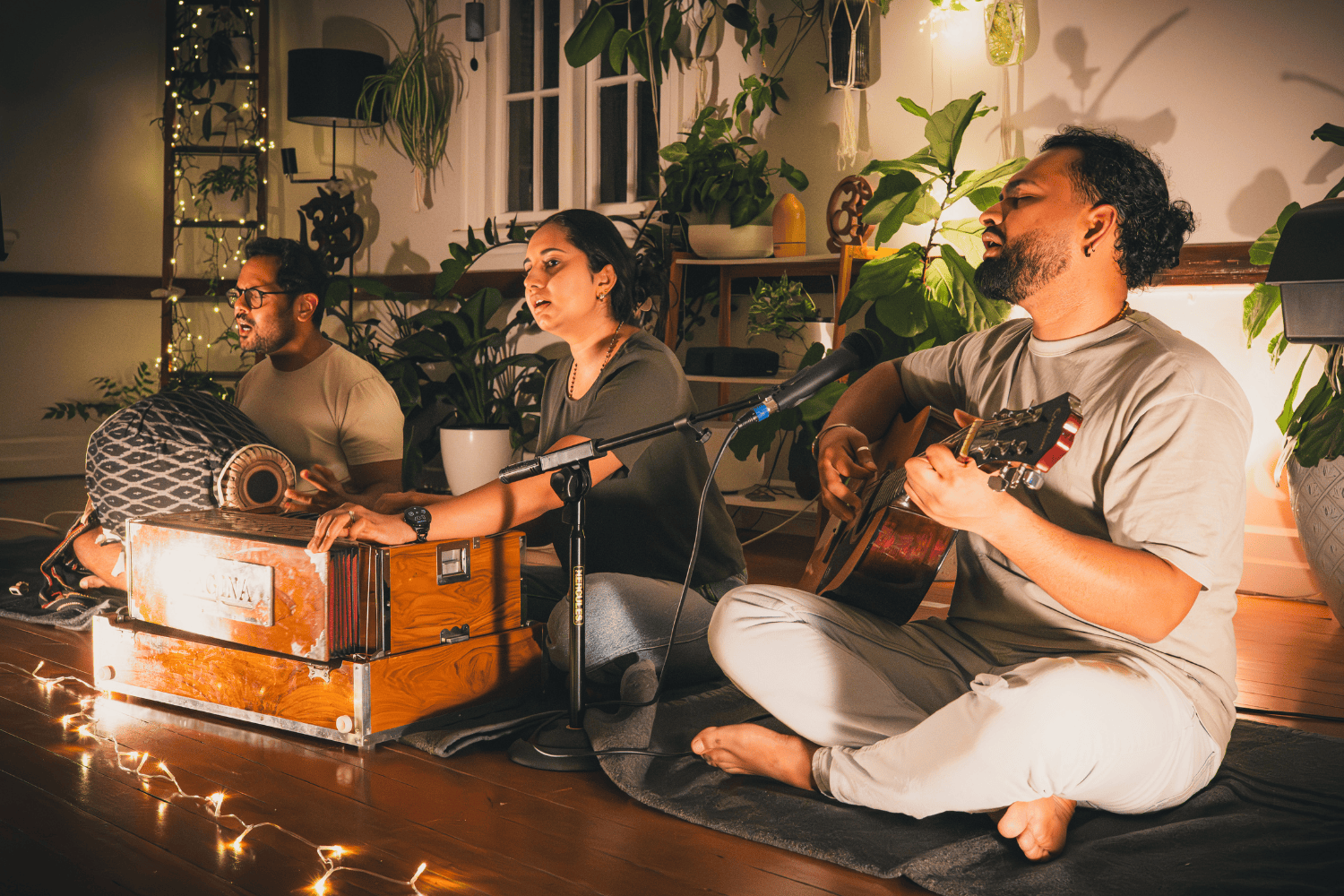
Kirtan can take many forms, but at Kirtan With Friends we follow a call-and-response pattern of singing.
This means that one person leading the chant sings first, and others follow as a response. It is not a musical performance, nor is it a one-person show.
The lead singer is supported by a group of musicians, often playing various percussion or accompanying instruments such as a drum, guitar, keyboard, or symbols, and at times a backup singer who sings with the rest of the room the response.
The goal is to create a harmonious sound in unison, so as to create a far more positive influence than we can as individuals.
The chants sung during kirtans consist of mantras. Man means “mind,” and tra means “to free”.
The purpose of chanting these mantras is to free our mind of the material contaminations that build throughout our everyday life, cluttering our minds and hearts and making it difficult to understand what is truly important to us.
Spiritual teachers explain that the sound vibrations that make up mantras are an incredibly powerful means to connect with the Divine.
In our everyday lives, we are constantly flooded by thoughts and desires with little control over where our minds take us.
Though most of us aspire to be less materialistic and worldly, it often seems like our thoughts inadvertently distract us from these aspirations.
Spiritual teachers explain that the sound vibrations promote clarity by taking us through three phases of consciousness.
In the first stage of chanting these mantras, we feel a sense of peace as our cravings for materialistic things gradually start to seem less important, allowing higher levels of awareness and consciousness to emerge.
In the second stage, these desires are all but absent and we begin to have higher, more spiritual aspirations for ourselves and those around us.
As we continue spiritual practice and align our lives to be more conscious, we can reach the third stage of absolute love towards the Divine and everyone around us.
This is all to say that the first time you experience kirtan, you may be surprised at how peaceful you feel, during and afterwards.
That is because the mantras we chant, most of which come from ancient Sanskrit or Bengali texts, have the power to calm our minds and strip away the mundane.
The effects of these mantras on our consciousness demand no exhaustive effort on our part, only the openness to hearing and chanting the mantra
During Kirtan with Friends sessions, the lead singer will often explain the meaning of the various mantras being chanted, which can help to create an intention for the practice.
The amazing thing, however, is that even if you don’t understand what the words mean, they will still have the same effect!
The Maha Mantra
The most popular mantras you will hear at Kirtan with Friends, and likely at other kirtan gatherings, is called the Maha Mantra.
This mantra consists of only three sacred names of the divine (Hare, Krishna, and Rama), strung into a chant with 16 words:
“Hare Krishna, Hare Krishna,
Krishna Krishna, Hare Hare,
Hare Rama, Hare Rama,
Rama Rama, Hare Hare.”
The word Krisha refers to the epitome of all Divine qualities, and literally means “the all-attractive one.” In the yogic tradition, Krishna represents the source of all truth, joy and spiritual knowledge. Chanting “Krishna” is a way to meditate on those qualities.
Rama evokes the Sanskrit term “to bring joy.” The calm joy and emotional steadiness we feel in kirtan are encapsulated in this word.
Hare refers to the energy of love, compassion and devotion, or the embodiment of connecting and offering oneself to others completely.
Spiritual texts explain that when these three words are combined into the Maha Mantra, not only the chanter, but anyone who hears the mantra experiences a cleansing of the mind and consciousness.
Through this process, misconceptions about one’s inherently spiritual identity are cleared away and replaced with a sense of freedom from what is termed the “blazing fire” of this world’s troubles.
Because of the immense and immediate effects of this particular mantra, it is called the Maha, or “greatest”, mantra.
What to expect from your first kirtan WITH FRIENDS?
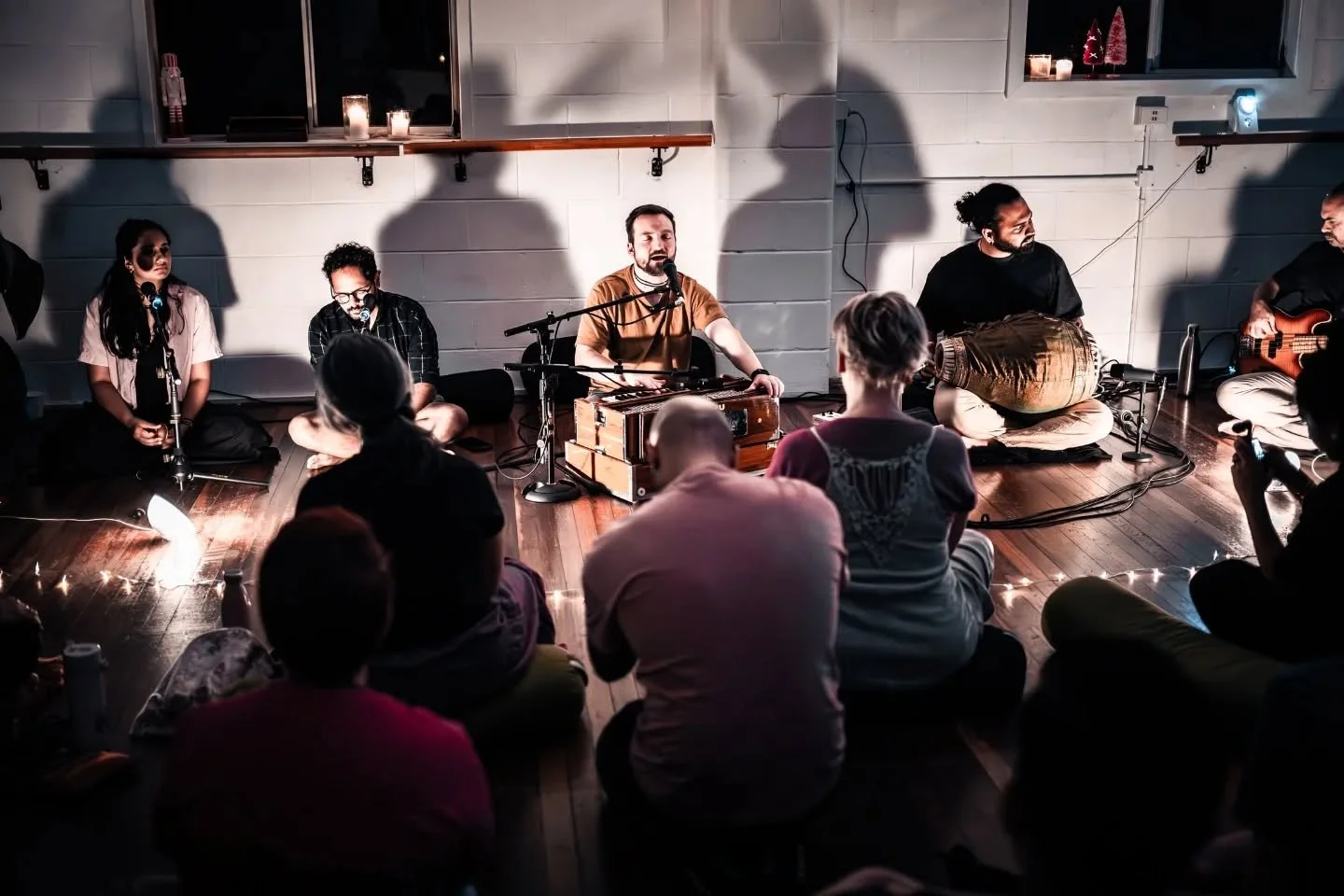
At Kirtan with Friends, we encourage everyone, whether familiar with or new to kirtan, to join in and participate as much as they are comfortable.
The evening generally starts with a brief introduction to the team and the singers of that session, followed by the chanting of the sacred syllabil of “Om” three times.
The chanting of “Om” helps us align our mind with our breath and shift awareness inward.
The first singer then sings a series of mantras on their own, which we fondly call "Gratitude Mantras.”
These mantras acknowledge generations of spiritual teachers who have passed down the practice of kirtan and spiritual wisdom, allowing us to benefit from it today. From here, the singer will usually transition into the first kirtan.
Each kirtan lasts anywhere from 15-30 minutes, and there will usually be three to four kirtans occurring in one session.
The mantras are displayed on a projector screen so that they are easily accessible, though some people choose to close their eyes once they’ve familiarised themselves with the mantra on the screen, as this can help to immerse themselves in the practice.
Kirtans generally start slowly and gradually build in speed, especially as we get further into the evening.
Some people choose to stand up, stretch their legs and perhaps even break out some casual dance moves, but this is completely optional.
After the kirtans are concluded, a vegan meal or snack is served. These events are all about community and connections, so we encourage you to strike up a conversation with someone you don’t know or chat with those you’ve met at other kirtan events.
